

Scenario Planning Without Building Forty Models
Scenario planning usually fails in one of two directions. Either the team builds one alternate case that is the base case with the growth rate lowered, or it builds so many permutations that nobody can hold the output in their head long enough to decide anything.
The second failure is the more expensive one, because it looks like rigor.
Where forty models come from
Nobody sets out to build forty. They arrive through arithmetic. Pick five variables that matter, revenue growth, input costs, wage inflation, collection timing, and one capital decision. Model each at three levels. That is 243 combinations before anyone has asked a single useful question.
Teams then prune to something manageable, but the pruning happens on feasibility rather than relevance. What survives is the set that was easiest to model, not the set that would change what the company does.
The permutation instinct is the problem. Scenario planning in FP&A is not an exercise in covering the possibility space. It is an exercise in identifying the small number of futures that would force a different decision.
Start from the decision, not the variable
A scenario earns its place only if it changes something you would otherwise do. That single test eliminates most of the forty.
Run it against your own list. If revenue comes in eight percent under plan, what changes? If the answer is that you would report a miss and carry on, that is not a scenario. It is a sensitivity, and a sensitivity table handles it in one row. If the answer is that you would delay a facility, restructure a credit line, or pull an acquisition, now it is worth modeling properly.
The distinction is worth holding firmly, because it determines how much work each one deserves. Sensitivities tell you how exposed you are. Scenarios tell you what you would do about it. Most teams build sensitivities and call them scenarios, then wonder why the output does not drive any action.
Choosing the three
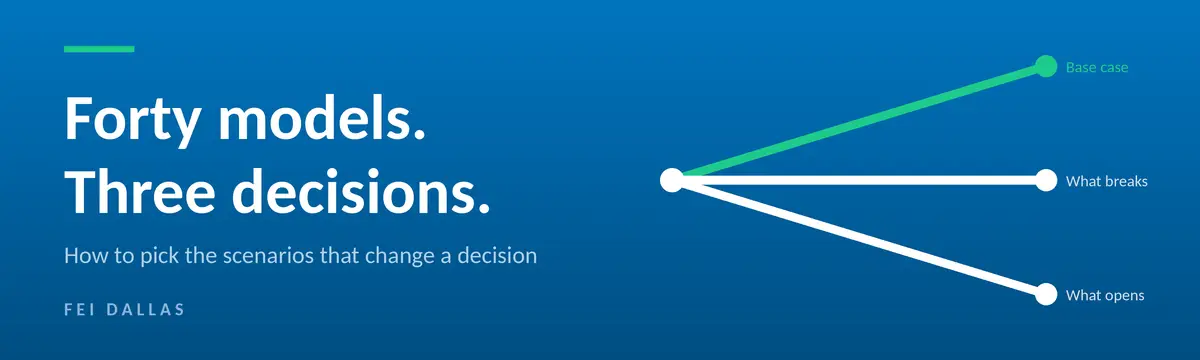
Three is not a magic number, but it is close to the practical ceiling for a board conversation, and it maps cleanly onto three different jobs:
1. The base case. What you would plan if current conditions persist. This is the one you actually operate against.
2. The case that breaks a decision you have already made. You have committed to something, a hire plan, a capex program, a covenant level. What set of conditions makes that commitment wrong, and how far away is it?
3. The case that opens a decision you have deferred. There is something you have been putting off because conditions did not justify it. What would justify it?
The second and third are where the value sits, and most scenario sets contain neither. Downside cases usually model a worse version of the same plan rather than the point at which the plan itself stops making sense. Upside cases usually go unmodeled entirely, which means opportunity arrives without a prepared response.
Each scenario needs a trigger, not just a number
A scenario without an observable trigger is a document. A scenario with one is a plan.
The trigger has three parts. An indicator you can actually see from where you sit. A threshold that is specific enough to argue about. And a named person who checks it on a stated cadence.
Without the third part it does not happen. The indicator gets watched enthusiastically for two months and then quietly stops being watched, usually right before it matters.
Good triggers tend to be operational rather than macroeconomic. Your own quote-to-close ratio, your collection aging, your temporary to permanent conversion rate, your win rate on renewals. These move before the published statistics do, and you see them first.
A worked example
Take the regional inputs we covered last week. Texas firms told the Dallas Fed in June that they expected input costs to rise 3.7 percent and selling prices 2.8 percent over the following twelve months. Reported wage growth accelerated to 4.0 percent between March and June, and the state labor force contracted at an annualized 0.7 percent through the first half of the year.
A base case built on those figures already contains margin compression, because inputs are expected to outrun prices by nearly a point. That is not a scenario, that is the plan.
The scenario worth building is the one where the labor constraint binds harder than expected and wage growth runs above 4.0 percent while pricing power stays where it is. The question that scenario has to answer is not what happens to EBITDA. It is which specific commitment breaks first, and what the trigger is that tells you it is breaking.
Build that one properly and skip the version where everything is five percent worse. You already know what that looks like.
What to skip
• Any scenario you would respond to identically to the base case
• Any variable you cannot observe until after the quarter closes
• Probability weightings, unless you can defend where the probabilities came from
• The fourth and fifth scenario, which almost always exist to demonstrate thoroughness rather than to inform a decision
The test
A scenario set is working when someone in the room can say what would have to be true for the company to change course, and roughly when they would know. If the output cannot support that sentence, the model was built to be comprehensive rather than useful.
Planning and forecasting come up in almost every session we run, usually because someone is midway through rebuilding theirs. Join us and compare approaches with finance leaders across North Texas.
https://feidallas.org/join/

Leave a Reply