

The Path from Controller to CFO
Nobody gets promoted to CFO for closing the books faster. The gap is elsewhere.
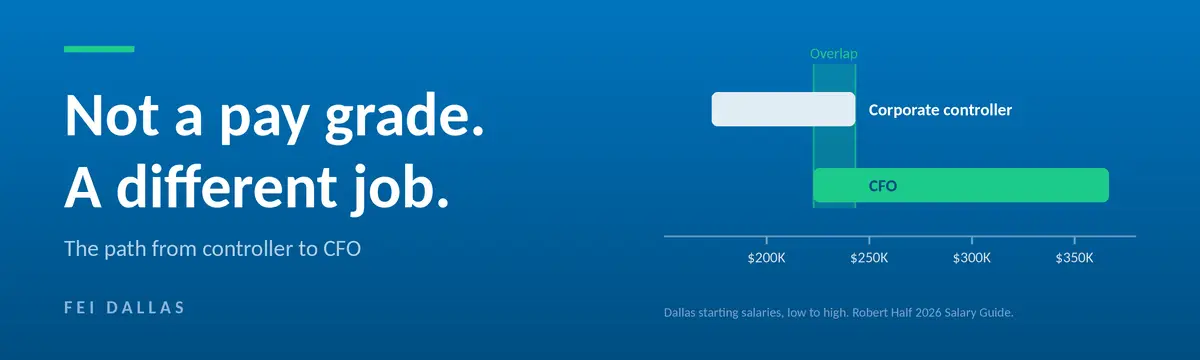
Start with a number worth sitting with. Robert Half’s 2026 Salary Guide puts the Dallas starting salary for a corporate controller with extensive experience at $243,105. For a CFO who is new to the role, it is $222,870.
The experienced controller starts $20,235 higher. These are starting salaries rather than total compensation, but the ranges genuinely overlap, and the top of one sits above the bottom of the other.
That tells you something about the controller to CFO path that the org chart hides. The step up is not a pay grade. It is a different job, and the qualities that make someone an exceptional controller are not the ones that set candidates apart for the seat above.
The market is unusually open right now
The timing for this conversation is better than it has been in years.
Russell Reynolds Associates tracks CFO appointments at listed companies across the major global indices. In 2025 it recorded 316 new CFO appointments, the highest figure in its seven-year series and 12 percent above its seven-year average. First-time CFOs accounted for 57 percent of them.
Its first-half 2026 data shows a record appointment rate, a year-over-year rise in the share of first-time CFOs, and a growing share of departures driven by retirement. The firm links those trends. As experienced CFOs retire, it suggests, the supply of seasoned finance leaders may tighten, making it more likely that organizations will need to consider first-time candidates.
In the first half of this year, seats opened at a record rate and a larger share went to first-timers than a year earlier. For a controller, that is the good news.
But the path usually runs through your own company
Here is the qualification. Russell Reynolds notes that where a ready internal successor exists, boards may be more willing to appoint a first-time CFO whose organizational knowledge and established relationships can support a smooth transition. Where the capabilities are not available internally, boards may need to search externally or use an interim appointment.
Read that carefully. In the firm’s framing, the natural home for a first-time appointment is an internal successor the board already knows. A first-time candidate the board knows is a manageable risk. A first-time candidate the board has never met is a harder sell against someone who has held the title before.
So the practical question is not whether the market will take a chance on you. It is whether the people who would make the decision already regard you as the ready internal successor. If they do not, the opening is much harder to reach.
If the internal route is closed
Sometimes the internal path is blocked for reasons that have nothing to do with readiness. The incumbent CFO is young and staying. The company is being sold. The board has already signaled it wants someone who has done the job before.
The external route has its own competition. Russell Reynolds found that experienced CFOs made up 43 percent of 2025 appointments, the highest share in its seven-year series, and its 2025 report describes organizations signaling a premium on proven CFO capability. A first-time candidate in an open search may well be competing against someone who has already held the title.
One answer is a trade on company size: taking the CFO title first at a smaller company, where the scope is broader even if the numbers are smaller, and where the whole mandate sits with one person rather than being divided among specialists. That trade can look like a step down on paper. It is also a direct way to become what those searches are screening for, which is someone who has already held the title.
It is worth being honest with yourself about which situation you are in before spending two years waiting for a seat that is not going to open.
What actually changes between the two roles
A controller owns the accuracy of what has already happened. A CFO owns decisions about what happens next.
That sounds like a slogan, but it changes almost everything underneath. A controller’s credibility rests on precision, and precision is a quality you can demonstrate every month. A CFO’s credibility rests on judgment with incomplete information, which can only be demonstrated in situations where the answer is not yet known.
The audience changes too. A controller typically answers to the CFO. A CFO answers to the CEO, the board, lenders, and in many companies investors, each of whom wants something different and none of whom is interested in how the reconciliation was performed.
Robert Half’s own description of the CFO role reflects that shift. It includes managing relationships with investors and investment institutions, identifying and managing business risks, and collaborating with technology leadership on systems decisions.
And the definition of a good month changes. For a controller, a good month is a clean close. For a CFO, a clean close is the assumption. A good month is a capital decision that holds up.
What boards are assessing
Russell Reynolds says today’s highest-performing CFOs are increasingly expected to act as enterprise-wide strategic orchestrators, aligning capital, technology, transformation, talent, and operational resilience while maintaining command of the finance fundamentals. That, it argues, raises the importance of assessing first-time candidates not only for technical readiness but for the judgment, learning agility, and leadership capacity the expanded mandate requires.
The fundamentals are the part a strong controller already has. The other five items on that list are where the gap sits, and almost none of them develop inside the close.
The credentials make the same point, and here the evidence is unusually direct. Robert Half’s description of the corporate controller role lists a typical ten years in finance and accounting, five of them in a managerial capacity, with employers preferring a CPA, CGMA or CMA, an MBA, and public accounting experience. Its description of the CFO role lists at least ten years in accounting or finance, a minimum of five in management, the same preferred credentials, and public accounting experience, and it names controller as one of the roles CFO candidates are expected to have held. The CFO description adds SEC reporting experience for public companies.
On paper, the baseline requirements for the two roles are nearly identical. Whatever separates a controller from a CFO, it is not in the stated requirements.
Where good controllers get stuck
One trap is being indispensable to the close.
The better a controller runs the month end, the more the organization depends on them running it, and the more expensive it becomes to move them. Excellence in the current role quietly becomes the argument for leaving them in it. Nobody decides this. It simply accumulates.
The way out is counterintuitive. Building a successor beneath you is not a threat to your position. It is the precondition for your next one. A controller whose departure would break the close is much harder to promote, however good they are, because promoting them creates a problem nobody wants to solve.
Another is staying inside finance. A controller whose relationships are almost entirely within the accounting function has little visibility with the people who will judge readiness, and little exposure to the commercial decisions a CFO has to make.
What to do in the next twelve months
None of this requires a title change first. It requires deliberately moving your work toward the decisions and the audiences of the role above:
• Take ownership of part of the forecast rather than only the actuals it is measured against
• Get involved in at least one capital decision from analysis through to approval
• Contribute to board materials, and ask to present a section rather than only prepare it
• Build a working relationship with the company’s lenders or auditors beyond the transactional
• Lead a project outside finance, where the stakeholders do not report to you
• Develop a named successor for your own role and make that person visible
Each of those creates evidence of judgment in front of people who will later be asked whether you are ready. That evidence is what turns a strong controller into a credible internal successor.
A note for the CFOs reading this
Your controller may well be your succession plan, whether or not anyone has written it down.
Russell Reynolds argues that boards can no longer treat CFO succession as a replacement exercise that begins when a departure is imminent, and that they need deeper pipelines and earlier development of potential successors. Much of that development work sits with the current CFO, and much of it is the list above. Delegating a forecast, bringing a controller into a lender meeting, or handing them a section of the board deck costs very little and builds exactly the readiness a board will later look for.
The controller to CFO path is shorter than it looks for people who are deliberately put on it. It is much longer for people who are left to excel where they are.
Career development and succession come up constantly in our programming, from both sides of the conversation. Join us to connect with finance leaders across North Texas who have made the move, and those developing the people who will: https://feidallas.org/join/
Disclosure: Robert Half is an FEI Dallas chapter sponsor. Its published salary data is cited here on the same basis as any other source.

Leave a Reply