

Board Readiness for Private Company CFOs
Most board reporting advice is written for a board you probably do not have.
Search for guidance on board reporting and much of it assumes one of two situations. Either a public company audit committee working to a disclosure calendar, or a private equity sponsor running a value creation plan on a monthly cadence.
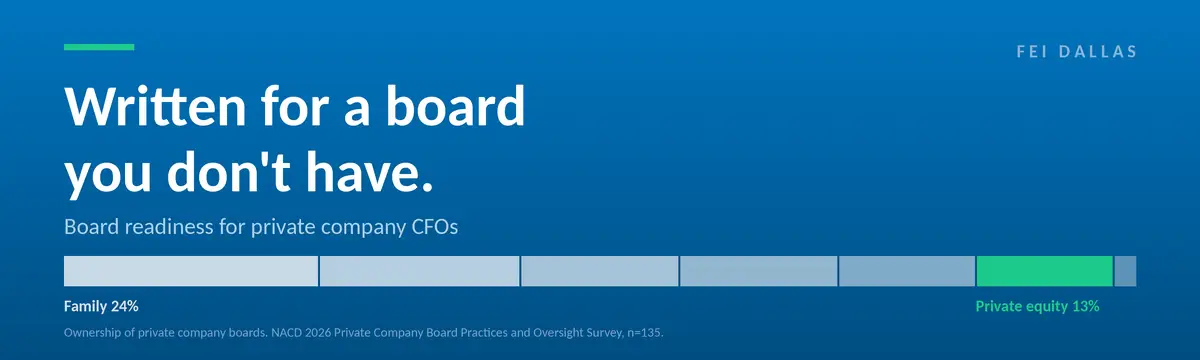
The National Association of Corporate Directors surveyed 147 people who serve on or support private company boards this spring. Among the 135 who described their ownership structure, private equity controlled companies accounted for 13 percent. Family controlled was the largest single category at 24 percent, followed by owner controlled at 19 percent, mutually controlled at 15 percent, and employee controlled at 13 percent. Separately, among the 100 who reported revenue, 79 percent were reporting on companies below $1 billion.
Family and owner controlled boards together made up more than four in ten of the ownership responses, against 13 percent for private equity. That is a materially different room from the one most board reporting guidance describes, and the difference changes what belongs in the pack.
Where oversight attention is moving
NACD frames its 2026 private company survey around three fronts where it says boards face mounting pressure to sharpen oversight: strategy execution, risk, and human capital. Its summary of the strategy section is the most useful line for a CFO. Boards, it says, must increasingly focus on forward-looking information and external trends impacting business conditions.
Read that as a statement about what directors want in front of them. Forward-looking information and external trends are not what most private company board materials lead with. Most lead with the month that just closed.
On risk, NACD describes private company boards working to formalize and strengthen enterprise risk management structure and processes. On human capital, it reports boards expecting AI and emerging technologies to reshape workforce strategy, with many acknowledging significant gaps in their oversight of workforce transformation.
The KPMG Board Leadership Center reached a similar place from a different direction, drawing on its conversations with directors and business leaders rather than a survey. On the 2026 Board Agenda sets out seven priorities, and the first four run in a revealing order. Strategy comes first, specifically reassessing the board’s engagement in scenario planning, agility, crisis planning and resilience. Then the company’s AI strategy and the governance and workforce needs around it. Then the adequacy of data governance, and whether cybersecurity governance is keeping pace.
The seventh is the one a CFO should read twice. KPMG advises boards to revisit risk oversight responsibilities and how they are allocated among committees. Who owns what is genuinely in flux.
The audit committee's remit is expanding into your work
KPMG’s companion audit committee agenda is the part with the most immediate consequences for finance.
It describes audit committee agendas continuing to expand beyond traditional financial reporting oversight into emerging risks and opportunities in areas including AI, cybersecurity, and sustainability. It also keeps financial reporting under tariff uncertainty on the 2026 priority list, and names the areas of US GAAP most susceptible to tariff effects: revenue recognition, inventory costs and the associated impairment risk, credit losses, and going concern.
Two things follow for private company board reporting. The first is that estimates and judgments exposed to cost volatility will attract more attention than usual, and the supporting logic needs to be in the materials rather than in your head. The second is that technology risk is now on the agenda of the committee that reviews your numbers, which means finance is likely to be asked for a view on it.
Where those questions land is still being worked out, and that is worth knowing before you build the pack. KPMG observes that for many companies AI oversight sits at the full board level, and that many boards are reassessing which committee has the time, expertise, and skill sets to take on data governance and perhaps cybersecurity.
For a CFO that ambiguity is an opportunity rather than a problem. Asking which body wants which material, before someone asks you for it, is a better position than discovering the answer in a meeting.
What changes by ownership structure
Generic advice fails here because the reporting job genuinely differs depending on who controls the company.
In a family controlled business, the board and the ownership group often overlap, and some directors may be there by inheritance rather than selection. The reporting challenge is rarely analytical sophistication. It is that decisions carry family consequences alongside financial ones, and material that ignores this reads as tone deaf. Clear separation between company performance and shareholder implications tends to help more than additional detail.
In an owner controlled business, the owner usually already knows the numbers, often better than the pack conveys. The board meeting is not where they learn what happened. Its value is in structured challenge, so materials that surface decisions and disagreements are worth more than materials that report results.
In an employee controlled or mutually controlled company, transparency expectations run higher and the audience for financial information is broader than the board itself. What goes into the board pack often has a second life in communications to the wider ownership base, and writing it with that in mind saves a great deal of rework.
In a private equity controlled company, the cadence is faster and the definitions are set by the sponsor. We covered that case separately in our piece on private equity reporting in the first hundred days.
What a private company board pack should carry
Working from what those reports describe, defensible private company board reporting has five parts:
A short forward view. Not the forecast model, but where conditions are heading and what has changed in the assumptions since the last meeting
Performance against plan, with variances explained by cause rather than restated by line item
Cash and liquidity, including runway under a downside case, not only the current position
A risk section that is the same shape every meeting, so directors can see what moved
The decisions requiring board input this meeting, named, with a recommendation attached to each
The last item is the one most easily left out, and the one that changes a meeting most. A pack that ends with decisions produces a discussion. A pack that ends with appendices produces questions you have already answered somewhere in the appendices.
The pre-read is where the meeting is won
A good share of what directors complain about in board packs is a timing problem rather than a content problem.
Material that lands the night before gets skimmed on a phone. Material that lands a week out gets read properly, and the questions that come back arrive by email rather than consuming the meeting. The practical difference between those two outcomes is a distribution date that finance controls.
Committing to a pre-read window you can actually hold is worth more than the extra polish you would gain by using those days for drafting. A nearly finished pack that gets read is more useful than a complete one that does not.
Same logic applies to length. A long pack is not evidence of diligence. It is a transfer of work from the person who wrote it to the people who have to find the important parts. If a section exists because it has always existed, it belongs in an appendix or nowhere.
Your first meeting as a new CFO
If you are new in the seat, the first board meeting establishes a pattern that is difficult to change later.
The temptation is to demonstrate command by presenting everything. That tends to backfire. Directors have limited evidence about you at that point, and a dense presentation invites them to test the detail rather than assess the judgment.
A better first meeting does three things. It presents the numbers in the format the board already recognizes, so the change in author does not arrive alongside a change in layout. It names one or two things you intend to change in future reporting and why. And it closes with a decision, however small, that the board can actually take.
Redesigning the pack is worth doing, but it is worth doing in the second or third meeting, once the board has a reason to trust the person doing the redesigning.
Three habits that cost credibility
The first is leading with the close. A clean close is the baseline expectation, not the headline. Opening with it signals that the finance function considers its job to be historical rather than forward looking, which is the opposite of the direction NACD describes.
The second is changing the format. Directors read private company packs the way people read any recurring document, which is by looking for what is different. Restructuring the layout to accommodate an interesting month destroys that, because everything looks different. Put the interesting month in the commentary and leave the structure alone.
The third is bringing a problem without a recommendation. The reasoning usually sounds like deference to the board’s authority. It reads as an absence of judgment. Bring the recommendation and the case against it. Being overruled on a clear recommendation costs nothing. Having no view costs a great deal.
The realistic version of readiness
Board readiness is not a project you complete before a meeting. It is the accumulation of packs that arrive on time, in the same shape, with the same definitions, ending in decisions the board can actually take.
The environment is pushing in a consistent direction. Boards are being asked to engage more deeply in strategy, to formalize risk oversight, and to govern technology while many acknowledge gaps in their own oversight of it. Each of those demands runs back through finance for the underlying information.
That is an opening. A private company CFO who moves the pack toward forward-looking material, holds the structure steady, and closes every meeting with named decisions is supplying what these reports describe boards needing. That is a stronger position than being the person who reports the month accurately.
Board dynamics come up in our programming regularly, from CFOs preparing materials and from members who sit on boards themselves. Join us to compare approaches with finance leaders across North Texas. [MEMBERSHIP LINK]
Disclosure: KPMG is the FEI Dallas chapter title sponsor. Its published research is cited here on the same basis as any other source.

Leave a Reply