

CFO AI Strategy: What Finance Leaders Must Own

By FEI Dallas Editorial Team · Updated 2026-08-07
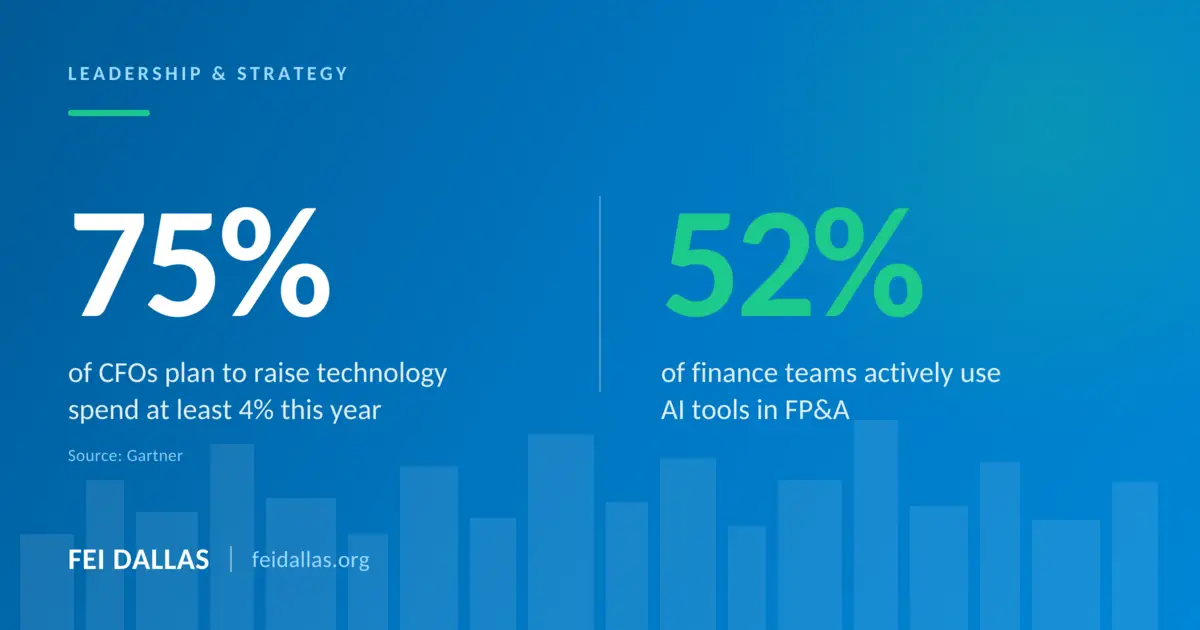
CFOs must own governance, data integrity, and accountability standards for AI in finance, not delegate them to IT. With 75% of CFOs planning to raise technology spend at least 4% this year, per Gartner, finance leaders should define approval workflows, validate model outputs, and set risk thresholds before scaling AI across FP&A, forecasting, and reporting functions.
Key Takeaways
75% of CFOs plan to increase technology investment by at least 4% this year, according to Gartner research.
CFOs prioritize modern, user-friendly financial tools with embedded AI capabilities for FP&A transformation over the next five years.
Finance leaders serve as gatekeepers for companywide AI adoption, controlling internal investment decisions and technology strategy.
Native AI capabilities automate workflows, enhance control, and save time while improving confidence in financial data and modeling.
75% of CFOs plan to increase technology investment by at least 4% this year, according to Gartner research.
CFOs prioritize modern, user-friendly financial tools with embedded AI capabilities for FP&A transformation over the next five years.
Finance leaders serve as gatekeepers for companywide AI adoption, controlling internal investment decisions and technology strategy.
Native AI capabilities automate workflows, enhance control, and save time while improving confidence in financial data and modeling.
Why Does AI Ownership Sit With the CFO?
CFO ownership of artificial intelligence stems from a role that has already expanded past budgets and financial statements. Finance leaders now carry responsibility for prioritizing technology investment and delivering real-time guidance across the business. That expanded mandate makes finance the natural home for CFO AI strategy decisions, rather than a function that simply waits on direction from IT.
Budget authority reinforces the case. Research from Gartner shows that 75% of CFOs intend to raise technology spending by at least 4% this year. Dollars moving at that scale rarely sit outside the CFO’s direct oversight.
Why isn't AI ownership left to IT alone?
IT manages infrastructure, security, and technical integration — but not financial judgment. CFOs bring the cross-functional view needed to weigh AI investment against every other capital priority. While every C-suite leader shares some responsibility for enterprise technology, the CFO is uniquely positioned to drive strategy that spans the whole organization and strategy that benefits finance specifically.
What does that ownership look like in practice?
CFOs operate on two tracks at once:
Sponsoring enterprise-wide AI initiatives that affect operations, sales, and customer service.
Directing finance-specific adoption, including forecasting, reporting, and accounts payable automation.
Sponsoring enterprise-wide AI initiatives that affect operations, sales, and customer service.
Directing finance-specific adoption, including forecasting, reporting, and accounts payable automation.
This dual role separates the CFO role in AI from every other executive seat at the table. Among corporate leaders, the CFO functions as champion and critical sponsor behind enterprise-wide AI efforts, not merely an approver of finance-department tools. That sponsorship role, paired with budget control, explains why finance AI adoption decisions consistently land on the CFO’s desk rather than in a separate technology committee.
What Belongs on the CFO's AI Checklist?
A checklist for finance leaders starts with governance, not tools. CFOs own the responsibility of making AI investments measurable, governed, and scalable, rather than letting adoption run as an unsupervised experiment. That distinction separates a real CFO AI strategy from a scattered collection of pilot projects.
The core job is tying spend to results. Finance leadership must ensure every AI investment improves business performance, connecting dollars spent to outcomes delivered. Without that link, finance automation ROI stays theoretical instead of measured.
How fast is CFO AI adoption actually moving?
Momentum is real but uneven. Fifty-nine percent of CFOs plan to significantly increase AI spend, signaling that CFO AI adoption has moved past curiosity into budget planning. Twelve percent haven’t started at all, citing weak AI literacy and systems that lag behind ambition. That gap between leaders and laggards is exactly what a checklist should close.
What makes finance AI adoption harder for mid-market companies?
Mid-market finance teams sit in an awkward middle. Their systems are often too complex for small-business tools. Too immature for enterprise-grade AI platforms built for far larger data volumes. This friction slows finance AI adoption even when leadership is fully committed.
A working checklist should force clarity on four fronts:
Governance ownership — who signs off on model use, data access, and risk exposure
Performance measurement — which metrics prove the investment improved outcomes, not just activity
Scalability path — whether the tool fits current systems or requires costly workarounds
Literacy gaps — what training closes the divide between early adopters and stalled teams
Governance ownership — who signs off on model use, data access, and risk exposure
Performance measurement — which metrics prove the investment improved outcomes, not just activity
Scalability path — whether the tool fits current systems or requires costly workarounds
Literacy gaps — what training closes the divide between early adopters and stalled teams
Skipping any of these four invites the same friction mid-market CFOs already report. A checklist without accountability is just a wish list.

Which Adoption Practices Actually Move FP&A?
Three practices separate finance teams that gain real traction from those stuck in pilot mode. Surveyed CFOs consistently name embedded intelligence, workflow automation, and dependable data as the levers that actually shift forecasting and reporting outcomes. Skipping any one of them stalls the other two.
CFO AI adoption succeeds when finance leaders anchor decisions to three demands echoed across CFO surveys:
Modern, embedded tools: CFOs rank user-friendly financial platforms with built-in AI as the top driver of FP&A transformation, not bolt-on software requiring separate logins or manual exports.
Native automation: Finance leaders want AI capabilities that save time, tighten control, and automate repetitive workflows directly inside existing systems.
Trustworthy modeling: Reliable data pipelines and forecasting models rank as a core priority, since confidence in the numbers determines whether leadership acts on AI-generated output at all.
Modern, embedded tools: CFOs rank user-friendly financial platforms with built-in AI as the top driver of FP&A transformation, not bolt-on software requiring separate logins or manual exports.
Native automation: Finance leaders want AI capabilities that save time, tighten control, and automate repetitive workflows directly inside existing systems.
Trustworthy modeling: Reliable data pipelines and forecasting models rank as a core priority, since confidence in the numbers determines whether leadership acts on AI-generated output at all.
Why does adoption lag if the value is clear?
Only about half of surveyed finance teams, 52%, report actively using AI-driven tools for FP&A. That execution gap shows up most clearly in how teams sequence rollout: adoption stalls when a tool is layered onto legacy reporting systems without a clear owner for data quality, or when finance staff are handed new AI features without training on how outputs should be checked before they reach a forecast or a board deck. Closing that gap means pairing every new tool with a named process owner and a validation step, not just a license.
What should CFOs prioritize first?
Sequencing beats speed. Finance leaders who succeed typically start with one high-friction workflow, such as variance analysis or cash forecasting, rather than attempting an enterprise-wide rollout. This narrower approach protects finance automation ROI by proving value quickly before broader finance AI adoption scales across FP&A, reporting, and AP/AR functions.
What governance questions must CFOs answer before adopting AI?
Every CFO AI adoption effort needs answers to two core questions: how does an autonomous finance agent reach a fair decision, and who is accountable when that system produces an error? These questions belong to finance leadership, not IT alone. Skipping them leaves gaps in data privacy, algorithmic transparency, and accountability that surface later, often during an audit or a client-facing failure.
How does governance strengthen finance automation ROI?
Strong governance protects the returns finance teams expect from automation. Without clear accountability, errors compound quietly across reporting cycles, eroding finance automation ROI before leadership notices. A documented framework catches problems early and keeps automated processes defensible under scrutiny.
CFOs advancing finance AI adoption should build governance around three commitments:
Assign named accountability for every AI-driven financial process, not a shared or vague ownership model.
Require transparency into how algorithms reach decisions affecting reporting or forecasting.
Audit data privacy controls on a recurring schedule, not just at initial deployment.
Assign named accountability for every AI-driven financial process, not a shared or vague ownership model.
Require transparency into how algorithms reach decisions affecting reporting or forecasting.
Audit data privacy controls on a recurring schedule, not just at initial deployment.
Trust follows accountability. CFOs who answer the hard questions first move faster later, with fewer surprises during audits, board reviews, or client-facing disclosures.
Where Can Finance Leaders Compare Notes on AI?
Peer networks give CFOs the fastest, most candid read on what AI actually delivers inside finance operations. FEI Dallas connects North Texas finance leaders through trusted peer networks, relevant programming, and a community built to give members a real return on time invested. Rather than relying solely on vendor pitches or generic case studies, finance leaders exchange firsthand accounts of pilots, rollouts, and failures within these networks.
That kind of exchange matters most for the CFOs still on the sidelines. Peer forums give them a place to ask the questions a vendor demo won’t answer: which governance model actually held up under audit, which rollout sequence avoided rework, and which tools disappointed after the pilot ended. Borrowing that judgment from peers who already made the mistakes is faster than discovering them independently.
Why does peer learning matter for CFO AI strategy?
A sound CFO AI strategy and broader finance leaders AI strategy rarely emerge in isolation. Comparing notes with peers facing similar governance, talent, and system constraints sharpens judgment before capital gets committed. FEI Dallas, based in Dallas, TX, positions itself to serve finance leaders wrestling with these adoption decisions across industries and company sizes.
What should finance leaders bring to these conversations?
Leaders get more value when they arrive with specifics: current tech stack limitations, expected finance automation roi, and open questions about CFO AI adoption timelines. Structured discussion, not casual networking, produces the sharpest insights. For additional perspective between sessions, finance leaders can explore ongoing industry insights covering adoption trends and governance practices.
FAQ
What should CFOs own in AI adoption for finance?
CFOs own governance, data integrity, and accountability standards for AI in finance. They define approval workflows, validate model outputs, and set risk thresholds before scaling AI across FP&A, forecasting, and reporting.
Why does AI ownership belong to the CFO instead of IT?
IT manages infrastructure, security, and technical integration, but not financial judgment. CFOs bring the cross-functional view needed to weigh AI investment against every other capital priority across the organization.
What does CFO AI ownership look like day to day?
CFOs sponsor enterprise-wide AI initiatives affecting operations, sales, and customer service while directing finance-specific adoption like forecasting, reporting, and accounts payable automation. This dual role sets the CFO apart from other executives.

Leave a Reply