

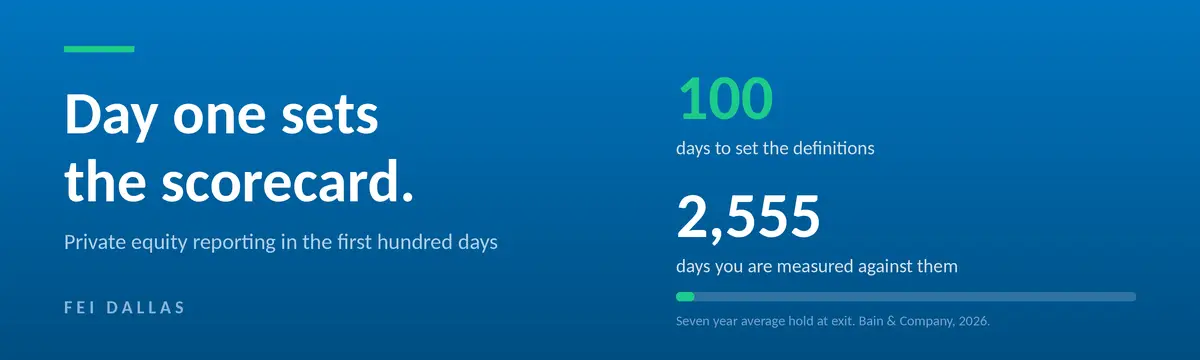
Private Equity Reporting in the First Hundred Days
The cadence changes on day one. The first monthly package sets expectations for the rest of the hold.
Most finance leaders taking a first sponsor investment prepare for the wrong thing. They prepare to produce more reports. The harder work is deciding what the reports say, because those decisions get made in the first few weeks and then govern how the company is measured for years.
It is worth understanding why the reporting ask has become heavier than it was a decade ago, because the reason is structural rather than stylistic.
Why the ask got heavier
The returns math that carried private equity through the 2010s has stopped working. Cheap debt and steady multiple expansion did a great deal of the lifting. With multiples flat, EBITDA growth has to carry the return on its own.
Bain’s 2026 Global Private Equity Report puts it as bluntly as a consulting firm will, asserting that twelve is the new five, meaning today’s deals demand materially faster EBITDA growth than the previous generation of deals did. The report’s own prescription for general partners is to move from full potential diligence to execution on day one.
Execution on day one requires operating visibility on day one, and that visibility has to come from your finance function.
The pressure behind it is real. Bain’s midyear report describes holding periods running to roughly seven years, well beyond historical norms, with firms sitting on around 33,000 unsold portfolio companies and exit activity still stalled. Distributions as a share of net asset value have held below 15 percent for four consecutive years, an industry record.
A sponsor holding an asset longer than underwritten, under pressure to show EBITDA growth without multiple expansion, and unable to return capital to its own investors, is not going to accept a reporting package built for a bank covenant and a tax return. That is the environment your first hundred days sits inside.
It is also an environment where more finance leaders are about to be in this position. KPMG’s 2026 M&A Deal Market Study, covering 150 corporate and 150 private equity dealmakers in the US, found 75 percent of private equity respondents expecting higher US deal volumes in 2026 than in 2025, against 57 percent of corporates.
The calendar arrives before the relationship does
The reporting calendar is usually set at close and is rarely negotiable afterward. Monthly packages tend to be due somewhere between five and ten business days after month end, which for many companies is half the close timeline they were running the week before.
The instinct is to solve this with effort. A team that produced a twenty day close produces a heroic eight day close in month one, on adrenaline and overtime, and then cannot repeat it in month two.
That first package sets the baseline. Everything afterward gets read against it, including the months when someone is on leave and the system is mid-migration. It is better to commit to a date you can hold in an ordinary month and hit it consistently than to establish a standard that depends on nobody being sick.
If the close genuinely cannot compress to the requested window without breaking, the first hundred days is when to say so, with a plan and a date. Sponsors handle that conversation far better in week three than in month seven.
The definitions matter more than the deliverables
Here is the part that gets underestimated. The quality of earnings report produced during diligence contains a definition of adjusted EBITDA, and that definition usually becomes the permanent scorekeeping standard for the investment.
It carries add-backs, normalizations, and run rate assumptions that were built to support a valuation at a point in time. Now they become things you have to track, evidence, and defend every month. Some of them are straightforward. Some assume a cost saving that has not happened yet, or a revenue run rate that reflects your best quarter.
Whatever was assumed in that model is now your budget. The adjustment that made the deal work has become your performance target.
Week two is the time to go through that definition line by line and establish, in writing, what each adjustment requires operationally, who owns delivering it, and what evidence will be produced monthly. That conversation is uncomfortable early and considerably worse in month nine when a number has not materialized and nobody remembers who committed to it.
KPI definitions are worth fighting over
The value creation plan will specify operating metrics, and a meaningful number of them will not exist in your systems in the form the sponsor expects.
Net revenue retention, gross margin by segment, customer acquisition cost, utilization, backlog conversion. Every one of these has three or four defensible definitions, and the gap between them can be substantial. If the sponsor’s operating partner has a definition in mind from a previous portfolio company and you have another from your own history, you will produce numbers that look like disagreement rather than arithmetic.
Settle the definitions before the first package rather than after. Write them down. A one page metric dictionary, agreed with the sponsor in the first month, prevents most of the credibility damage that portfolio company finance teams suffer in year one.
It also protects you. A metric you defined and documented is a metric you can defend. A metric that drifted into use undefined is one you will eventually be accused of moving.
Lender reporting runs on its own track
Sponsor reporting and lender reporting are different obligations with different deadlines, different definitions, and different consequences for being late.
Compliance certificates, covenant calculations, and borrowing base reporting follow the credit agreement, not the sponsor’s calendar. The adjusted EBITDA definition in the credit agreement may also differ from the one in the value creation model, sometimes with caps on specific add-backs that the sponsor’s version does not contain.
Running two definitions in parallel is normal. Discovering in month four that you have been running two definitions without realizing it is not. Reconcile them early and keep the bridge between them as a standing schedule.
Cash reporting gets granular fast
Thirteen week cash flow forecasting becomes standard in most sponsor backed companies, and it is often the single largest change in workload for a finance team that previously forecast cash monthly at a summary level.
It is also the report that gets read most carefully in the first year. A sponsor evaluating whether the finance function is in control looks at whether the thirteen week forecast holds up against actuals. Variance in the first few weeks of the horizon is a signal about operating grip, not just about collections.
Building it as a maintainable weekly process rather than a spreadsheet one person assembles by hand is worth the setup time, because it does not go away.
If it is a carve-out, everything above gets harder
Carve-outs deserve separate treatment, because a growing share of sponsor activity is portfolio separation rather than whole company acquisition. KPMG’s 2026 Global M&A Outlook, a survey of 700 senior dealmakers across 20 countries fielded between December 2025 and January 2026, found 71 percent of private equity respondents open to or actively pursuing portfolio separation, with 55 percent already having carve-outs under consideration. KPMG has called 2026 the year of the carve-out.
If your situation is a carve-out, the reporting problem is different in kind rather than degree. The business has no standalone historical financials, because it never existed as a standalone business. What exists is an allocation, and the allocation was built for management reporting inside the parent rather than for external scrutiny.
That creates three problems that arrive in the first hundred days:
• Standalone financials have to be constructed, often for periods before anyone in the new entity was responsible for them
• Transition services agreement costs need tracking separately, with an end date that is closer than it looks and a cliff behind it
• Stranded costs, meaning the parent overhead that was allocated to you and the replacement function you now have to build, usually exceed the diligence estimate
The TSA schedule in particular is worth reading closely in week one rather than month four. It specifies what the parent will keep doing, for how long, and at what price, and every line on it is something you have to stand up before the clock runs out. Finance is usually on several of those lines.
The capacity conversation has a window
The new reporting load is real work. A weekly thirteen week cash process, a monthly package on a compressed timeline, lender compliance on a separate calendar, and operating metrics your systems do not currently produce. A team sized for the previous cadence cannot absorb all of that by working harder, and pretending otherwise for two quarters is how good finance teams lose people.
The first hundred days is when you have the most leverage to address it. The value creation plan is being funded, the sponsor expects investment in the platform, and nobody has yet signed up to a budget that assumes the current team can carry the load.
Wait until after the first budget cycle and the same request becomes an overrun against a plan you approved. Sponsors generally treat finance capacity as an investment rather than an expense, particularly when it protects reporting they depend on. What they respond badly to is discovering the gap through a missed deadline.
Make the case in terms they use. Headcount and systems spend framed against the reporting obligations in the value creation plan reads as operating discipline. The same request framed as the team being busy does not.
Add-ons arrive sooner than you think
A large share of sponsor investments are platform deals, where the thesis assumes acquisitions on top of the original company. If yours is one, the reporting consequences land earlier than most finance leaders expect. The same KPMG global survey found 37 percent of private equity dealmakers expecting to complete more than five deals in 2026, against 20 percent of corporates, so the pace behind a platform thesis is not hypothetical.
Purchase accounting, opening balance sheets, integration reporting, and pro forma or same store views arrive on top of everything already described, often before the base reporting has stabilized.
It is worth asking directly in month one whether the thesis includes add-ons and on what timeline, because the answer changes what you build now. Reporting architecture designed for a single entity gets torn out and rebuilt when the second acquisition closes. The same architecture built with a consolidation layer from the start does not, and the incremental cost of doing it that way at the outset is small.
What the first hundred days should actually produce
Not a heroic close. A set of agreements:
1. A reporting calendar you can hold in an ordinary month, agreed in writing
2. A line by line walk of the adjusted EBITDA definition, with an owner and an evidence source for every adjustment
3. A one page metric dictionary agreed with the sponsor, covering every KPI in the value creation plan
4. A reconciliation between the credit agreement definition and the sponsor definition, maintained as a standing schedule
5. A thirteen week cash process that runs weekly without depending on one person
6. A capacity plan for the new reporting load, agreed while the value creation plan is still being funded
7. An honest map of what your systems cannot currently produce, with dates
That last item is the one most people skip, and it is the one that buys the most goodwill. A finance leader who says in month two that segment margin will take until Q2 because the chart of accounts has to change is managing the relationship. One who discovers the same thing in month six is delivering bad news.
The thing nobody tells you
Your credibility with a sponsor is established faster than seems fair, and it is established on consistency rather than brilliance.
The reports that land on time, with the same definitions, reconciling to the same source, in the same format, month after month, do more for the relationship than any single impressive analysis. The first hundred days is where that pattern gets set, and the pattern is very hard to reset once it is established in either direction.
Disclosure: KPMG is the FEI Dallas chapter title sponsor. Its published research is cited here on the same basis as any other source.

Leave a Reply