

Board Meeting Season: Preparing the Package
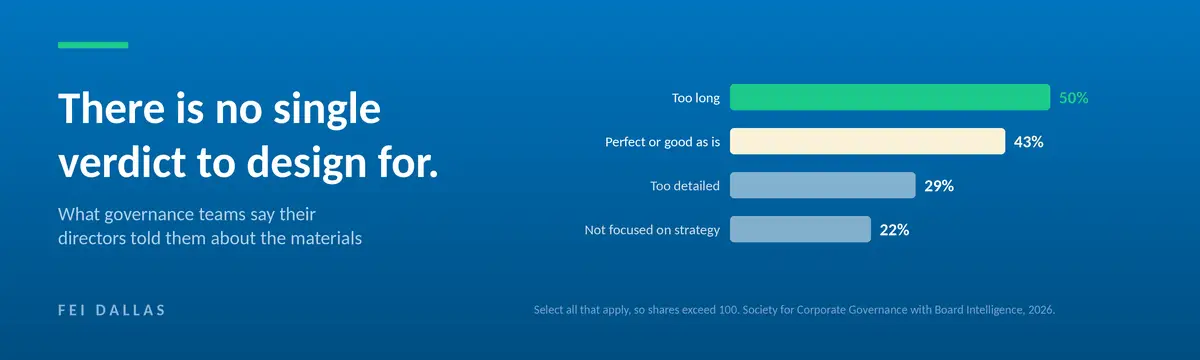
Half of governance teams report directors telling them the materials are too long. Forty-three percent report being told they are fine as is. Both answers came from the same question.
The Society for Corporate Governance, working with Board Intelligence, asked the people who actually assemble board materials what their directors had told them over the previous two years. Respondents could select all that applied.
Fifty percent reported hearing that materials were too long. Forty-three percent reported hearing they were perfect or good as is. Twenty-nine percent heard too detailed, and 22 percent heard not sufficiently focused on strategy.
Those first two figures are the honest starting point for any CFO board presentation. There is no single verdict to design against. Some boards want less, and a sizeable share are satisfied. The useful question is not whether packages are too long in general. It is what your board has actually told you, and whether anyone has asked them lately.
Lead time is measured, and most organizations send materials at least a week out
That same Society report, published in spring 2026, is one of the few places where the mechanics are measured rather than asserted. It draws on five member surveys fielded between June 2024 and December 2025, with 191, 195, 135, 153 and 110 respondents, plus two roundtables of 153 and 107 participants and a set of structured interviews. Respondents come from publicly traded, privately held, nonprofit and government-owned organizations.
Fifty-five percent of organizations distribute materials at least one week in advance of the meeting. Thirty-eight percent distribute less than one week ahead.
The more interesting number is internal. Thirty-nine percent of corporate secretaries receive final or near-final materials less than one week before distribution, many only a few business days before posting or on the same day. If your package goes out late, that figure suggests the constraint may sit upstream, in the close and review calendar, rather than with whoever sends the package.
What directors say would improve oversight
Corporate Board Member and the Diligent Institute surveyed over 200 actively serving US public company directors in the fall of 2025 for the 23rd annual edition of What Directors Think. One question asked which actions they would recommend to optimize their board’s governance oversight, selecting all that applied.
More time for strategic planning led at 58 percent. Increased exposure to outside parties and experts followed at 45 percent, fewer presentations and more discussion at 42 percent, and access to AI-powered technology for board work at 40 percent. More lead time to review board materials drew 19 percent, which placed it seventh among sixteen options rather than at the bottom of the list.
More than twice as many directors recommended fewer presentations and more discussion as recommended more lead time. Because the question allowed multiple selections, some directors chose both, and the survey does not report the overlap.
Two findings from the same survey cut the other way and belong here. Only 9 percent of directors said they always receive real-time or near-real-time operational data between meetings, with a further 38 percent saying often; the remaining 53 percent said sometimes, rarely or never. And asked what would most improve their board’s risk oversight, with up to two choices, 20 percent chose improved management reporting. Directors are not asking for a thinner information diet across the board. They are asking for less of it delivered as a presentation.
EY’s board effectiveness survey, covered in the next section, points back at the directors on one count. Asked which practices would elevate their peers’ contributions over the next year, 31 percent chose adopting a more effective meeting preparation routine. Some of the distance between what is sent and what lands sits on the receiving end, and no amount of package design closes that part.
Information quality is the highest-ranked driver and the most divided
EY surveyed 107 directors for Inside the effective board, published in June 2026. Asked to name the top three drivers of board effectiveness, 72 percent included the quality and flow of management information, more than any other factor.
On two further top-three questions, 50 percent placed it among the areas their board performs best, and 39 percent placed it among the areas most needing improvement. EY notes it is the only area where director views diverge that significantly.
Those are rankings rather than verdicts. Thirty-nine percent putting information flow in their top three for improvement does not mean 39 percent consider their board deficient at it. What it does mean is that no other aspect of board effectiveness produces that split, and information flow is the piece of it a finance team touches most directly.
Worth noting for this audience: EY describes its sample as 107 directors serving companies across a range of industries and company sizes, and does not state whether those companies are public or private. Thirty-four percent serve companies below one billion dollars in revenue, and private equity appears among the listed sectors.
What private company directors say management does worst
KPMG’s Board Leadership Center surveyed 274 private company directors between March and June 2025. Asked which elements of strategic planning have proven most challenging for management, selecting up to three, directors named assessing market trends, customer expectations and the competitive landscape at 49 percent and scenario planning and risk analysis at 48 percent. Among directors at private equity-owned companies, a subgroup of 59 respondents, the market assessment item drew 58 percent.
Asked to rate management’s scenario planning process area by area, 55 percent said identifying potential impact and assigning probabilities for each scenario needs improvement, and 49 percent said the same of developing multiple plausible scenarios including compound risks.
Directors also want into that work rather than away from it. Asked where the board adds the most value in scenario planning, selecting up to two, 65 percent chose providing input on management’s scenario planning updates and results.
KPMG asked about management’s strategic planning capability, not about board materials, so the connection to your package is an inference rather than a finding. It is a reasonable one: the market view and the scenario work are the two areas this audience’s directors single out.
Lead with what is on the agenda
The Corporate Board Member survey also asked what is most pressing for the next board meeting, up to three selections. Strategic planning took 47 percent, AI and other digital and technology risks and opportunities 44 percent, merger and acquisition opportunities 35 percent, and financial conditions and navigating macro shifts including capital access 32 percent. Chief executive and C-suite succession followed at 20 percent.
If the package opens with a detailed variance walk and reaches strategy on slide 23, it is ordered against that list rather than with it. The variance work still has to exist. It does not have to go first, and it does not have to be read aloud to people who can read.
The AI gap is measured, and it is a reporting gap
NACD’s 2025 public company survey asked which AI oversight activities boards had performed, on a base of 146 respondents. Sixty-two percent had set aside agenda time for full-board discussion of AI. Just over 6 percent had established metrics for management reporting on it. Approving an annual budget toward AI projects drew under 9 percent.
So most boards in that sample have made room for the conversation, and very few have told management what to report. That is an unusual position for a CFO to find an agenda item in.
Private company directors describe the same shortfall from the other side. In KPMG’s survey, 24 percent were satisfied or very satisfied that their board understands the risks posed by the use of generative AI, 30 percent that it understands the company’s use of and plans for it, and 27 percent that it understands the potential impact on the business model. On whether the company is implementing governance approaches for effective, ethical and responsible use of generative AI, the figure was 32 percent.
Meanwhile the finance function is already inside the decision. Deloitte’s third quarter 2026 CFO Signals survey, covering 200 North American CFOs at organizations with at least one billion dollars in annual revenue, found nearly 80 percent saying finance has a formal role in AI-related decisions, with 41 percent as required approvers and 38 percent defining or administering the evaluation framework. Only 20 percent provide cost, budget or accounting guidance without shaping the decision.
The same survey found that for 53 percent, reviewing AI costs retrospectively is the primary practice, while 47 percent monitor usage costs in or close to real time, and that 40 percent cite a lack of AI cost governance, processes or policies as a barrier to oversight. Those are three separate populations across these studies and none of them measures the others. Taken together they describe a reporting slot that boards have opened, have not specified, and that finance is already positioned to fill.
What is still not measured
Two things you will see quoted are not established by any survey we could find. Board book page counts are one. The Society report mentions directors receiving 300 to 500 or more pages, but as an illustration rather than a measured distribution. Director preparation hours on their own are the other. The Society report does not measure them, and Spencer Stuart’s 2024 director pulse survey reports total hours of board work with preparation included rather than preparation alone.
Treat the confident figures that circulate online with care: an average pack length, a reading speed per hour, an annual cost of producing materials. Those trace to vendor advisory work or client samples without a stated population, sample or fielding window, and some cannot be traced to a published document. Lead time, by contrast, is measured, and the figures above are the ones to use.
Five questions for this cycle
Worth answering before the next package goes into the portal:
· When did you last ask your own board what they think of the materials, rather than inferring it? Half of governance teams have been told too long and more than four in ten have been told they are fine.
· How many slides will be read aloud to people who have already read them, and what would you do with that meeting time instead?
· Do your scenarios carry assigned impacts and probabilities, or just labels? Among the scenario planning areas KPMG asked about, that is the one private company directors most often said needs improvement.
· Where does strategy sit in the running order, against the 47 percent of directors who named it the most pressing item for their next meeting?
· If the board asked what AI cost this quarter and what it returned, could you answer from the package? In NACD’s 2025 survey, about 6 percent of public company boards had established metrics for management reporting on AI.
None of this requires a new reporting system. It mostly requires treating the package as an instrument for a conversation rather than a record of work completed. Our earlier piece on board readiness covers the governance side of the same problem.
Chapter gatherings are a good place to compare notes with peers on what lands with a board. Join us at an upcoming session. FEIDallas.org
Disclosure: KPMG is the FEI Dallas chapter title sponsor. Its published research is cited here on the same basis as any other source.

Leave a Reply