

Q4 Financial Planning: Questions Worth Settling Before December
The regional forecast you built the plan on has already moved. That is the argument for settling these now.
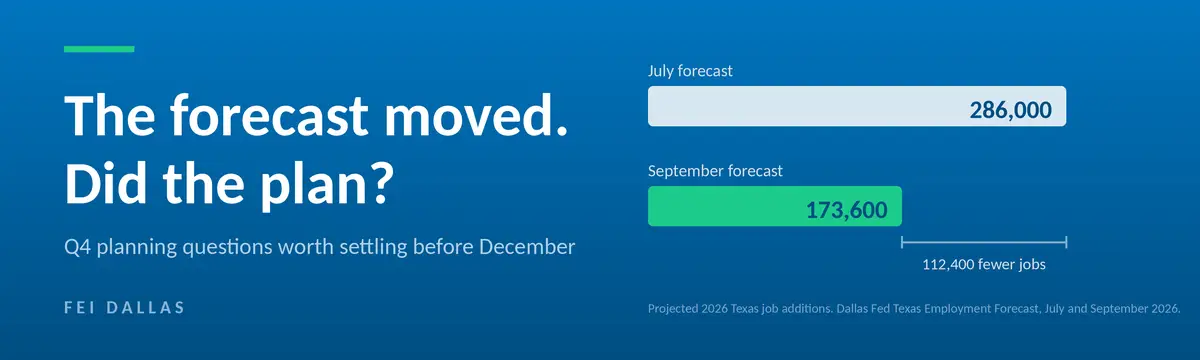
In July the Dallas Fed forecast Texas employment growth of 2.0 percent for 2026. Its September forecast puts the same year at 1.2 percent, with an 80 percent confidence band of 0.8 to 1.6 percent.
In jobs, that is a move from roughly 286,000 added this year to 173,600, a reduction of about 112,400. Part of the move is a revision rather than a downturn. The Dallas Fed’s Luis Torres noted that first quarter benchmark revisions lowered the state’s year to date employment growth to a pace more consistent with labor supply constraints, with year to date growth now at 1.0 percent against a long-run average of 2 percent.
If your planning assumptions about the regional economy were set over the summer, the published figure behind them has since been cut by 40 percent. That is the honest case for Q4 financial planning as something more than a calendar exercise, and it is why the questions below are worth settling in October rather than discovered in February.
Which assumptions in the plan are already stale?
Start by listing every external assumption the plan rests on and marking the date each one was set. Regional growth, wage inflation, input costs, interest rates, demand in your largest segment.
Assumptions tend to get treated as settled once they are entered. They are not. The Texas revision is a useful example because part of what moved was measurement rather than conditions. Benchmark revisions changed the reading of growth that had already occurred. Plans built on the earlier figure were not wrong when they were built, and they are out of date now.
The practical version of this question is a single page listing each assumption, its value, its source, and the date. Anything older than the last quarter gets refreshed before the plan is approved rather than after.
What is the merit budget actually built on?
This is where a stale assumption costs real money, because compensation is often the largest controllable line and the hardest to reverse once committed.
RSM’s Middle Market Business Index for the third quarter, based on 501 responses collected in July, found 57 percent of middle market executives had increased compensation during the quarter and 66 percent expected to increase it over the following six months. That window runs through the back half of this year and into the next, which is the stretch in which you are setting the number.
A merit budget set against last year’s figure, when two thirds of surveyed middle market executives expect to raise pay, is a retention risk you are choosing to carry rather than one you have priced.
Where does margin actually land?
The most useful number in the RSM data is not a single figure but a gap.
In the third quarter, 75 percent of RSM’s respondents reported paying higher prices while 66 percent reported raising their own. Looking forward, 76 percent expect to pay more and 70 percent expect to charge more. In both cases a larger share of firms is absorbing cost increases than passing them on, by nine points on current conditions and six on expectations.
These are counts of firms rather than a measure of how much margin moved, so the gap is a direction rather than a magnitude. The direction still matters. If your plan assumes cost inflation and shows margin holding flat, the pass-through assumption inside it is doing a lot of work, and it is worth finding which line carries it before the board asks.
Is capital expenditure being committed or deferred?
RSM found 57 percent of firms increased capital spending in the third quarter and 65 percent expect to raise capital outlays over the next six months. The index itself eased to 111.8 from 113.6, which is a slight cooling well above the 100 line that separates expansion from contraction.
So sentiment softened marginally while investment intentions stayed strong. For a Q4 conversation that combination is worth naming explicitly, because the common failure is a plan that quietly defers capex to protect a margin target and never says so. Deferral is a legitimate decision. Deferral by omission is a decision nobody made.
Ask which specific projects are in the plan, which are in the plan but unfunded, and which have quietly moved to next year. The third category is the one that rarely gets written down.
What will trigger a reforecast, and who decides?
A reforecast often gets triggered when someone senior becomes uncomfortable. That works, in the sense that it eventually happens, and it means the trigger is a mood rather than a number.
Settling this in October costs very little. Name two or three indicators, set a threshold on each, name who checks them and how often, and agree what happens when one breaches. Useful triggers tend to be operational rather than macroeconomic, because you see your own numbers first: win rate on renewals, collection aging, temporary to permanent conversion, order backlog.
We covered the mechanics of this in more detail in our piece on scenario planning, including why three scenarios usually beat forty.
What does the board need to see, and when?
If the plan goes to a board or a lender in the first quarter, the material is due earlier than the deadline suggests, and the questions are more predictable than the timing implies.
Directors will want to know which assumptions changed since the last plan, what the downside case does to covenant headroom, and what management would do about it. None of those require new analysis in January if the work is done now.
The reason October and not November
In practice, the teams that settle these questions in October are the ones that finish planning in December. Start in November and February becomes likely, because every unresolved question turns into a meeting and December has fewer working days than the calendar suggests.
None of these questions take long to answer. They take long to answer when four people disagree and nobody has the authority to decide, which is a different problem and one that gets worse as the year closes.
Planning and forecasting come up in our programming every year around this point, usually because several members are mid-cycle and comparing notes. Join us at an upcoming session.
Disclosure: RSM US is an FEI Dallas chapter sponsor. Its published research is cited here on the same basis as any other source.

Leave a Reply