

The North Texas CFO Outlook: What Finance Leaders Are Watching
The regional headlines and the regional balance sheets are telling different stories right now.
The Texas economy is having a good year by every measure that makes a headline. Job growth accelerated through the second quarter. The Dallas Fed revised its 2026 employment forecast upward. Company outlooks among its survey contacts improved through June and July after a weak start to the year.
Read one layer down and the picture gets more complicated. The labor force is shrinking. Wage growth is accelerating and has spread past the sectors where it started. Temporary and staffing employment is growing many times faster than payrolls overall. And inflation is now the top concern among Texas businesses, cited by the largest share since the Dallas Fed introduced the question in 2022.
None of that contradicts the growth. It changes what the growth costs, and that is the part worth building into a plan.
The number that will get quoted
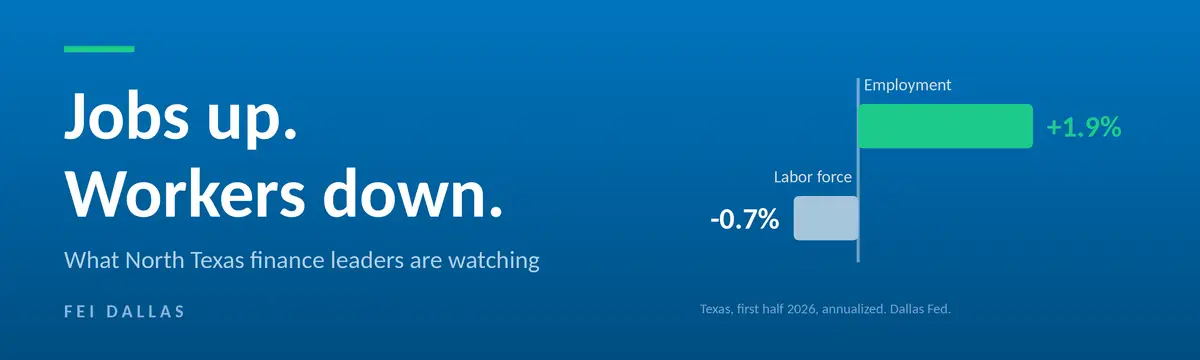
Texas employment expanded at an annualized 2.4 percent in the second quarter, up from 1.5 percent in the first. Across the first half of the year the state grew 1.9 percent annualized against 0.6 percent nationally, restoring the roughly one point premium Texas usually holds over the country.
On the strength of that, the Dallas Fed raised its 2026 employment forecast to 2.0 percent, up from 1.1 percent at the start of the year. That works out to roughly 286,000 jobs added statewide and employment near 14.6 million by December.
The local numbers were stronger still. Employment in the Dallas metro division rose an annualized 3.7 percent in June after 1.3 percent in May. Fort Worth came in higher at 3.9 percent. Only Austin, at 5.8 percent, grew faster than either. Dallas unemployment held at 4.3 percent, just under the statewide 4.4 percent.
If you are presenting a Dallas economy outlook to a board this quarter, that is the slide. It is accurate, it is current, and it is good news.
The number that will not
The Texas labor force contracted at an annualized 0.7 percent over the first half of 2026. During the same stretch last year it grew 1.2 percent.
So hiring accelerated into a shrinking pool. That is a materially different economy from one where hiring accelerates because more people became available to hire, and it produces different second order effects on any operating plan built off the headline growth rate.
Immigration policy is part of it. In a July survey question, 14 percent of Texas firms said policy changes over the past year had affected their ability to hire and retain foreign-born workers, and many of those firms reported leaning harder on contract labor, subcontracting, or outsourcing as a result. The Dallas Fed was careful to note that hiring difficulty is not confined to firms that typically depend on immigrant labor. Competition for skilled workers is broader than that.
For anyone building a 2027 plan, the practical implication is that labor availability, not demand, is the binding constraint on capacity in most North Texas sectors right now. Plans that assume you can staff to forecast are making an assumption the data does not currently support.
Wage pressure left manufacturing
Average annual wage growth reported by Texas firms accelerated from 3.5 percent to 4.0 percent between March and June.
The composition matters more than the headline. Manufacturers reported the most intense pressure at 4.8 percent over the past year, the fastest pace since December 2023. But the notable move was in services, where wage growth reversed a downward trend and rose to 3.8 percent in June. Service sector expectations for the coming twelve months accelerated to 3.5 percent from 3.0 percent in March.
That reversal is the signal. Wage pressure concentrated in manufacturing is a sector problem. Wage pressure that has crossed into services is a labor market problem, and it reaches almost every company in the region regardless of what it makes or sells.
The data center buildout is a visible driver. One heavy industrial construction contractor told the Dallas Fed it had been paying $28 to $32 an hour for skilled concrete workers while data centers were offering $45 an hour plus a $150 per diem. Contacts also described poaching serious enough that firms were reposting roles they had filled three to six months earlier.
If your merit budget was built on the 3.5 percent reading from the spring, it was built on a number that has since moved half a point in the wrong direction.
The growth is being staffed, not hired
Staffing services payrolls in Texas surged an annualized 22.0 percent in the first half of the year, adding roughly 32,000 jobs. Nationally the same category grew 3.8 percent.
Staffing is usually treated as a leading indicator because temporary employment adjusts faster than permanent headcount. The interesting wrinkle is what firms told the Dallas Fed about why they were using it. They described turning to temporary hires to meet demand amid labor shortages, rather than hedging against uncertainty. One recruiting firm described real difficulty finding the right talent when a need arises.
That is a different motive than the usual one, and it points somewhere different. Temp hiring as a hedge against a soft economy tends to unwind quietly. Temp hiring as a workaround for a shortage tends to convert, or to persist at higher cost.
Whether it converts is worth watching directly. The Dallas Fed named it as one of its own key indicators for the coming months, and it is a cleaner read on regional confidence than most sentiment measures, because it involves firms committing real money.
Inflation moved to the top of the list, and expectations did not
Nearly half of Texas firms ranked inflation among their three biggest concerns in June, up from 40 percent in March. That is the largest share since the Dallas Fed introduced the question in September 2022. A national CFO survey run by the Atlanta and Richmond Feds picked up the same rise among executives.
Yet the expectations those same firms report barely moved. Texas businesses expected input costs to rise 3.7 percent and selling prices 2.8 percent over the following twelve months, at or slightly below where those expectations sat in March.
The gap between concern and expectation is the useful part. The Dallas Fed’s own reading is that firms increasingly treat inflation as an upside risk to monitor rather than an outcome already embedded in their pricing plans. The Dallas Fed suggests the forces behind the worry, principally the Iran war and tariffs, may be expected to prove temporary or to reach only a limited number of firms.
For planning purposes those are two separate inputs. Concern belongs in your risk register and your scenario set. Expectation belongs in your base case. Conflating them produces a plan that is priced for an outcome nobody has actually forecast.
What is specific to Dallas
Two things distinguish DFW business conditions from the statewide picture, and both cut in interesting directions.
The first is concentration in financial services. Financial activities account for 10.1 percent of total employment in Dallas, a higher share than New York City at 9.9 percent, Boston at 9.6 percent, Chicago at 6.9 percent, and San Francisco at 6.5 percent. The sector employed 317,000 people here in June, more than any other Texas metro. The Dallas Fed also noted the Texas Stock Exchange opening for trading in its July report.
The second is the relocation pipeline. Dallas leads major Texas metros in corporate headquarters relocations, drawing 125 companies between 2015 and 2024. Nearly half came from California at 47.2 percent, followed by New York at 6.4 percent and Illinois at 5.6 percent.
Here is the honest complication. In the three months ending in June, job gains across Dallas were broad based, and financial activities was the one sector that declined slightly. A single quarter in a single sector is not a trend, and it would be a mistake to read much into it. But it is a reminder that a strong metro number and a soft number in your own sector are not contradictory, and that the aggregate figure on the board slide may not describe the market your company actually operates in.
Fort Worth is now measured separately, and it should be
The Dallas Fed began publishing a standalone Fort Worth report this year, its ninth regional report, on a bimonthly schedule. That is a useful development for anyone who has been treating the metroplex as one market.
The two economies are built differently. Trade, transportation and utilities account for 23.9 percent of Fort Worth employment against 19.5 percent in Dallas and 19.4 percent statewide. Manufacturing runs 9 percent in Fort Worth against 6.5 percent in Dallas and 6.8 percent statewide. Fort Worth unemployment was 4.0 percent in May, below the 4.3 percent statewide rate that month. Average nominal hourly wages there were $37.23, up 3.4 percent from a year earlier, and the median home sale price was $355,000, down 0.6 percent year over year. Census figures released this year also rank Fort Worth as the tenth most populous city in the country.
For a finance leader that difference is not trivia. A goods and logistics weighted economy transmits tariff changes, freight costs, and industrial wage pressure differently than a services and finance weighted one. If you have operations on both sides of the metroplex, the same regional headline is describing two different sets of conditions, and the aggregate DFW number splits the difference between them.
What this changes in the plan
Nothing here argues for pessimism. The regional economy is expanding, the forecast moved up rather than down, and business outlooks improved.
The argument is narrower. The composition of this growth should change several inputs:
Build merit and wage assumptions off 4.0 percent, and off a rising services expectation, rather than the 3.5 percent figure from the spring
Treat labor availability rather than demand as the capacity constraint in operating plans
Track your own temporary to permanent conversion rate as a leading indicator, since it reflects committed spending rather than sentiment
Keep inflation concern in the scenario set and inflation expectation in the base case, and do not let the first quietly reprice the second
Separate regional performance from sector performance before drawing conclusions about your own market
What to watch from here
The Dallas Fed named three things it is monitoring, and they are a reasonable list for anyone building a North Texas CFO outlook for next year. Whether the surge in staffing converts into permanent hiring. Whether skilled worker shortages persist and keep wage pressure elevated. And how trade policy developments affect business investment decisions in the coming months.
All three resolve on a timeline that lands inside most planning cycles. That is unusual, and it argues for building the reforecast trigger into the plan now rather than deciding in February whether the assumptions still hold.

Leave a Reply