

M&A Readiness: What Diligence Exposes First
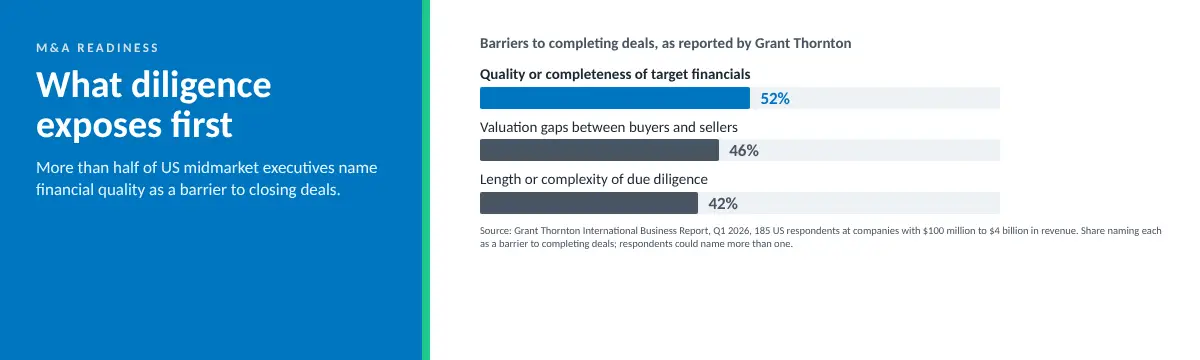
More US midmarket executives name the quality of a target's financials as a barrier to completing deals than name anything else. Among private equity buyers, concern about scrutiny of financials has risen while the two leading valuation concerns have fallen by about half.
This is the week a particular conversation happens. Everyone is in the same room, the business comes up, and someone asks what happens to it in five years. In closely held and family-owned companies that question has a way of starting something, and whatever it starts eventually arrives at the same place: a stranger reading your financial statements with no reason to believe them.
That is an observation rather than a statistic, and the rest of this piece is the other way round. The timing is worth naming because the gap between deciding to explore a sale and being ready to withstand diligence is measured in reporting cycles, not weeks.
The most cited barrier is not the price
Grant Thornton’s International Business Report is a quarterly survey of mid-market business leaders. In the first quarter of 2026, among 185 US respondents at companies with annual revenue between $100 million and $4 billion, 52 percent identified the quality or completeness of target financials as a barrier to completing deals.
Grant Thornton then lists other key buyer concerns: valuation gaps between buyers and sellers at 46 percent, and the length or complexity of due diligence at 42 percent. Two things are worth saying about that. Grant Thornton calls financial quality the top barrier but does not publish a full ranked list, so the other two are the concerns it chose to report, not necessarily the second and third of a longer set. And with 185 respondents, a six point gap between 52 and 46 is not a difference you would want to lean on hard.
What survives those caveats is still useful. Financial quality is at least level with price as an obstacle among US midmarket companies with $100 million to $4 billion in revenue.
The buyer-side picture is more complicated, and more interesting
KPMG runs a twice-yearly survey of US dealmakers. Its study published in February 2026 reports fieldwork from its year-end 2025 wave, covering 300 respondents split evenly between corporate dealmakers at companies with at least a billion dollars in revenue and private equity respondents at firms with fund sizes of at least $500 million. Its mid-year 2026 wave, published in August, repeats several questions.
Asked to name the single biggest valuation-related challenge in executing deals, private equity respondents at year-end 2025 put uncertainty in forecasting targets’ future performance first at 34 percent and unrealistic seller price expectations second at 31 percent. Heightened scrutiny on financials, which KPMG labels as quality of earnings concerns, came last of six options at 2 percent.
That figure does not support this article’s argument, and it belongs here anyway. By mid-year 2026 the same question produced a different picture. Forecasting uncertainty had fallen from 34 percent to 18 percent. Seller price expectations had fallen from 31 percent to 14 percent. Heightened scrutiny on financials had risen from 2 percent to 11 percent.
So among private equity buyers, concern about financial scrutiny rose while the two that dominated dropped by roughly half. The other three options together rose from 33 percent to 57 percent, so financial scrutiny is not the only concern gaining ground; KPMG’s chart does not let us match those three to their individual values. A low level and a rising trend are different claims, and only the second one is being made here.
A note on the corporate half of that chart. KPMG’s published document confirms the pairing of its top three corporate answers through its own commentary, but the lower-ranked options are only matched to their values by list order, so no corporate figure for heightened scrutiny on financials is cited here.
Where diligence does rank first
In KPMG’s mid-year 2026 private equity survey, respondents were asked which challenges have posed the greatest risk to value realization in their experience. Inadequate diligence or underwriting assumptions was the top cited risk at 37 percent, narrowly ahead of ineffective financing structure or constraints at 34 percent, on a multi-select question with 150 respondents.
In the year-end 2025 study, asked about primary focus areas for ensuring value realization, 50 percent of corporate respondents and 64 percent of private equity respondents named proper integration due diligence.
Read alongside the trend above, the shape is consistent. Buyers do not currently describe your financial reporting as their biggest pricing problem. They do cite diligence quality most often as a risk to value realization, and the two are the same information in different hands.
Valuations are not what is stopping deals
It is worth testing the obvious alternative, that financial quality only leads because pricing has already settled.
In the year-end 2025 study, 57 percent of corporate respondents said valuations are high but not preventing deals, 25 percent said they are about right, and 13 percent said they are too high and are preventing deals. Among private equity respondents, 66 percent said about right, 31 percent high but not preventing deals, and 3 percent too high and preventing them.
On the buy side, then, price is largely not the blocker. The qualification is that Grant Thornton’s midmarket respondents see it differently: 46 percent named valuation gaps between buyers and sellers as a barrier. The two surveys cover different populations, larger corporate and private equity dealmakers in KPMG’s case and midmarket business leaders in Grant Thornton’s, so the difference is worth noting rather than explaining away.
What quality and completeness usually means in practice
No survey we could find enumerates what diligence turns up, line by line, with a stated sample. The categories below are practitioner knowledge rather than survey findings, and they are offered on that basis.
· Revenue recognition that was never formalized, where the policy lives in one person’s judgment rather than a written treatment a buyer can test against a sample of contracts
· Cut-off, where revenue and expenses land in the period that suited the month rather than the period they belong to, which surfaces the moment anyone runs a consistent twelve-month view
· Addbacks that cannot be evidenced, where the owner’s compensation, the personal expenses and the one-time items are real but undocumented
· Customer and supplier concentration that the reporting does not surface, because nobody has ever been asked to produce revenue by customer for three years
· Working capital that has never been normalized, so there is no agreed baseline and the peg becomes a negotiation conducted under time pressure
· Inventory and reserve policies applied inconsistently year to year, which looks like earnings management whether or not it was
None of those are accusations of bad bookkeeping. Most are the ordinary consequence of a finance function built to produce a tax return and a bank covenant certificate, which is a different job from producing a defensible earnings figure for someone who intends to pay a multiple of it.
Diligence is not an audit, and the difference changes what you prepare
An auditor asks whether last year’s statements are fairly stated. A buyer asks whether next year’s are predictable, and then whether their own plan stacked on top of yours is achievable.
KPMG’s mid-year survey found 60 percent of corporate dealmakers underwriting synergies of 10 to 40 percent of the target’s current EBITDA, with 12 percent above 40 percent. Among private equity respondents the same bands come to 52 percent and 19 percent. That synergy case gets built on your numbers. Where the granularity is missing, a buyer either builds it on assumptions and then discounts those assumptions, or asks you to build it during diligence, which is slower and demonstrates how much of it did not previously exist.
What they are buying points the same way. KPMG’s mid-year corporate respondents named long-term value creation at 61 percent, market and customer expansion at 55 percent and scaling existing businesses or portfolios at 52 percent as their investment theses. Grant Thornton’s US respondents separately named strengthening competitive position at 62 percent, acquiring new capabilities or technology at 61 percent and expanding into new markets at 59 percent as strategic objectives. Those are two different surveys asking two different questions, so the overlap is thematic rather than a measured agreement. Both describe buyers underwriting growth, which means they need to see where growth comes from, customer by customer and line by line.
The market is active, with a caveat on who is buying
In the Grant Thornton survey, 84 percent of US respondents expected midmarket M&A activity to increase over the following 12 months, with 28 percent predicting a significant rise.
KPMG’s mid-year corporate respondents reported 84 percent expecting deal volume to remain the same or increase against the first half. That panel was screened to organizations above a billion dollars in revenue that plan at least one deal in the remainder of the year, so a healthy volume expectation is close to built into the sample and should be read accordingly. Among private equity respondents, 45 percent expected higher volumes in the second half than the first, while 49 percent reported lengthened deal timelines.
Deal size cuts two ways. Sixty-two percent of corporate respondents estimated their next deal at under $500 million in total value. KPMG does not report the revenue of targets, so that figure says nothing direct about company size. Private equity moved the other way: 39 percent expect their next deal to exceed $1 billion, against 5 percent at year-end 2025.
An active market with slower processes is one where preparation separates outcomes. The cost of being unprepared is not that you cannot transact. It is that you transact slowly, on someone else’s terms, while findings accumulate.
The argument, stated as an argument
Here is the claim this article is making, which no survey cited above tests directly.
A buyer who cannot verify your historical numbers cannot build a forecast they trust. A forecast they do not trust gets discounted, and the discount arrives in the conversation as a disagreement about value. The seller experiences a valuation argument. The buyer is managing an information problem.
Grant Thornton’s own commentary supports the mechanism without quantifying it, noting that when earnings quality is uncertain, valuation ranges widen, pricing turns conservative, diligence expands, structural protections such as earnouts tied to future performance appear, and debt financing becomes harder to obtain or comes on less favorable terms. Palash Misra, a partner at Grant Thornton | Stax, puts the process effect plainly: when financials are incomplete or difficult to validate, the firm tends to see more staging in the process. In our view, staging is also where leverage moves.
The part that cannot be done in the data room
Everything above describes problems that are cheap to fix two years out and expensive to fix under exclusivity.
A written revenue recognition policy, tested against a sample of contracts, is routine work in a normal quarter. Produced during diligence, it is an admission that no policy existed. Three years of clean revenue by customer is a reporting build. Assembled retroactively under a deadline, it is a reconciliation exercise with a buyer watching the variances.
Most of this work improves the business whether or not a transaction ever happens, which is the argument to make internally when there is no deal on the table and no urgency to point at.
Where to start if the conversation has started
· Could you produce a consistent, reconciled twelve-month view of revenue by customer and by product line this week, without a special project? Many buyer questions route through it.
· Is your revenue recognition policy written down, and would it survive someone testing it against ten contracts they chose rather than ten you chose?
· Which of your addbacks can be evidenced with a document rather than explained in a meeting? Price the ones that cannot.
· Has anyone calculated a normalized working capital baseline on your own numbers, before a buyer proposes one? The peg is easier to defend than to dispute.
· If the answer to the family question this week is yes, who owns the readiness work, and what are they being taken off to do it?
The conversation that starts over a long weekend does not usually produce a decision. It produces a direction. The useful thing to do with a direction is start the reporting work early enough that it is finished before anyone needs it, which is a very different experience from discovering the gaps while a buyer documents them.
Chapter gatherings are a good place to hear from peers who have been through a process. Join us at an upcoming session. [MEMBERSHIP LINK]
Disclosure: KPMG is the FEI Dallas chapter title sponsor. Its published research is cited here on the same basis as any other source.

Leave a Reply